

For support and service of your machinery, Stiles has experts available 24/7 to help reduce downtime and get you back in action.
Technical Support: 616-698-6615
Service & Repairs: 616-698-7500
24/7 Parts: 1-800-727-8780
sale@inlandmachineokc.com
Parts are available from Stiles 24 hours a day, seven days a week, and are shipped from our Grand Rapids, Michigan fulfillment center.
24/7 Parts: 800-727-8780

With a customized Stiles University course, we can provide expert training for your team, on-location. Whether it's programming, operation or maintenance, we want to help you train your personnel to meet your production goals efficiently and effectively.

Experience the trusted workforce development training and machinery knowledge you rely on from Stiles University, now at your convenience. With technology changing every day and new methods being developed constantly, Stiles University Online has the latest information and training content available at your fingertips.
616-698-7500

Do you want to produce more efficiently? Processes and flows are key. We optimize these together with you, re-organize them and make sure that you reduce your lead time and save costs. This enables you to implement customized manufacturing and achieve your business goals.

Industrialized construction is evolving. Automation, robotics and advanced technology are raising the level of productivity, efficiency and precision for builders in North America.

Stiles Machinery is at the forefront of providing technology and machining for producing high quality mass timber. Automated solutions for your mass timber production can increase your manufacturing quality and productivity.

Project management services from Stiles make it easy to streamline your entire project— from concept and consultation to integration and implementation.
For support and service of your machinery, Stiles has experts available 24/7 to help reduce downtime and get you back in action.
Technical Support: 616-698-6615
Service & Repairs: 616-698-7500
24/7 Parts: 1-800-727-8780
sale@inlandmachineokc.com
Parts are available from Stiles 24 hours a day, seven days a week, and are shipped from our Grand Rapids, Michigan fulfillment center.
24/7 Parts: 800-727-8780

With a customized Stiles University course, we can provide expert training for your team, on-location. Whether it's programming, operation or maintenance, we want to help you train your personnel to meet your production goals efficiently and effectively.

Experience the trusted workforce development training and machinery knowledge you rely on from Stiles University, now at your convenience. With technology changing every day and new methods being developed constantly, Stiles University Online has the latest information and training content available at your fingertips.
616-698-7500

Do you want to produce more efficiently? Processes and flows are key. We optimize these together with you, re-organize them and make sure that you reduce your lead time and save costs. This enables you to implement customized manufacturing and achieve your business goals.

Industrialized construction is evolving. Automation, robotics and advanced technology are raising the level of productivity, efficiency and precision for builders in North America.

Stiles Machinery is at the forefront of providing technology and machining for producing high quality mass timber. Automated solutions for your mass timber production can increase your manufacturing quality and productivity.

Project management services from Stiles make it easy to streamline your entire project— from concept and consultation to integration and implementation.
For support and service of your machinery, Stiles has experts available 24/7 to help reduce downtime and get you back in action.
Technical Support: 616-698-6615 Service & Repairs: 616-698-7500 24/7 Parts: 1-800-727-8780
Parts are available from Stiles 24 hours a day, seven days a week, and are shipped from our Grand Rapids, Michigan fulfillment center.
24/7 Parts: 800-727-8780For support and service of your machinery, Stiles has experts available 24/7 to help reduce downtime and get you back in action.
Technical Support: 616-698-6615 Service & Repairs: 616-698-7500 24/7 Parts: 1-800-727-8780
Parts are available from Stiles 24 hours a day, seven days a week, and are shipped from our Grand Rapids, Michigan fulfillment center.
24/7 Parts: 800-727-8780Steel Castings turn molten metal into components shaped for demanding service. A foundry pours liquid steel into a prepared mold, then controls cooling, cleaning, and inspection. The result can be a pump casing, rail component, valve body, or large industrial housing. Some parts weigh only a few kilograms. Others require heavy lifting equipment to move across the foundry floor.
The scale of metalcasting helps explain its industrial importance. The World Casting Production Census, published by Modern Casting with support from the World Foundry Organization, reported roughly 110 million metric tons of castings worldwide in 2022. That figure covers many materials, not steel alone, so it should not be mistaken for steel-casting output. Still, it shows how widely cast components serve manufacturing, transport, energy, and infrastructure. Industry surveys also reveal a varied sector, where production methods and quality demands differ by part and market.
Steel Castings are valued for strength, design flexibility, and their ability to form complex shapes. They can be specified for wear, pressure, or elevated-temperature service, though performance depends on alloy selection, casting design, and process control. They are not automatically the best choice. Machining, testing, and heat treatment can add time and cost, and defects remain possible if controls fall short. A sound selection starts with the operating conditions, not a broad claim that steel is always stronger. This guide examines common types, practical uses, and benefits, while noting where trade-offs deserve closer attention.
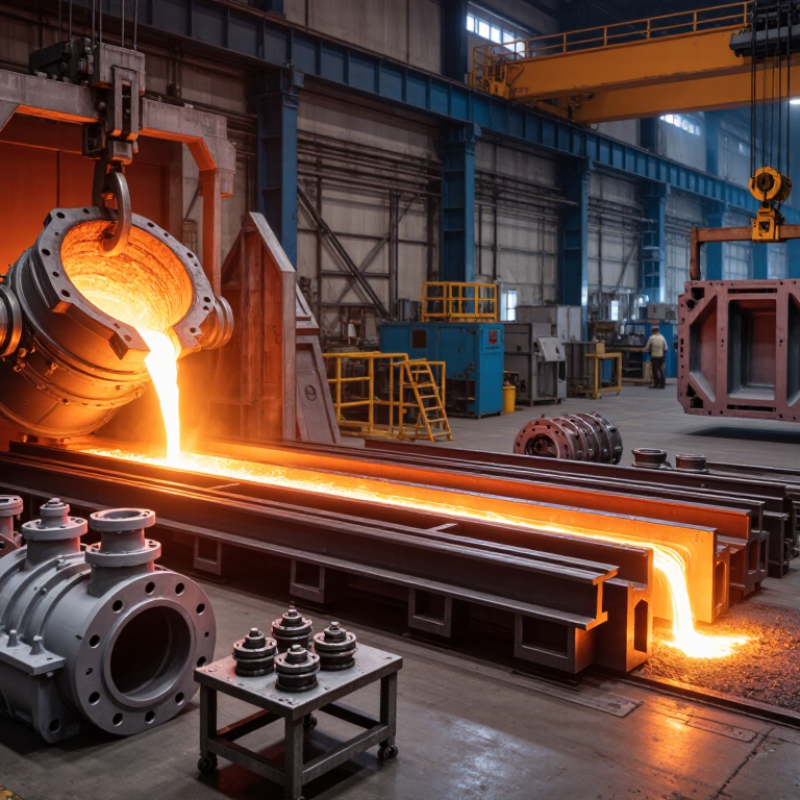
Steel castings are metal components formed by pouring molten steel into a designed mold. After cooling, workers remove the mold, clean the surface, and inspect the part. This process creates complex shapes that may be difficult to produce through forging or machining.
Common types include carbon steel, alloy steel, and stainless steel castings. Carbon steel suits general structural duties. Alloy steel improves strength, wear resistance, or toughness. Stainless steel supports demanding environments involving moisture, chemicals, or heat. Typical applications include pump bodies, valve parts, mining equipment, rail components, and heavy machinery frames.
The World Steel Association reported about 1.89 billion tonnes of crude steel production in 2023. That figure shows the scale of the steel industry, although castings represent only one segment. The International Energy Agency also identifies iron and steel production as responsible for roughly 7% to 9% of global energy-related carbon dioxide emissions. Material efficiency therefore matters.
A well-designed casting can reduce assembly work and handle heavy loads. It can also distribute stress through thick, irregular sections. However, castings are not automatically stronger. Porosity, shrinkage, inclusions, and uneven cooling can weaken a part. In practical inspection, radiographic or ultrasonic testing may reveal defects hidden beneath a smooth surface. The boundary is not always neat. Designers should match steel grade, mold design, heat treatment, and inspection level to the actual service conditions. That step is often underestimated.
Steel castings are classified by chemistry, performance, and production method. Carbon steel castings contain mainly iron and carbon, offering practical strength for frames, housings, valves, and general machinery. Low-alloy steel castings add elements such as chromium, nickel, or molybdenum. These grades improve toughness and wear resistance under pressure. High-alloy and stainless steel castings resist corrosion, heat, or chemical exposure. They suit pumps, energy equipment, process vessels, and marine components.
The 2023 World Steel in Figures report recorded about 1.89 billion tonnes of global crude steel production. This scale supports a broad casting supply chain, although crude steel output is not the same as casting volume. That distinction matters. The U.S. Geological Survey’s Mineral Commodity Summaries 2024 also links steel demand to construction, transport, machinery, and energy infrastructure. In practice, engineers often select sand castings for large, complex parts because tooling costs remain manageable. Investment castings deliver finer details and closer dimensions. Centrifugal castings work well for rings, tubes, and cylindrical components.
Performance depends on more than the grade name. ASTM specifications define chemical limits, mechanical properties, and test requirements for several casting families. Heat treatment can change hardness and toughness significantly. Defects still occur. Gas pores, shrinkage cavities, and inclusions may weaken a part despite correct chemistry. Inspection methods such as radiography, ultrasonic testing, and magnetic particle testing help reveal hidden problems. A careful specification should state load, temperature, corrosion exposure, wall thickness, and inspection level. Vague material choices create expensive surprises.
Steel casting begins with a pattern that defines the part’s shape and dimensions. For sand casting, workers pack prepared sand around the pattern to form a cavity. Cores create internal passages, such as holes for fluid flow. The pattern is removed, and the mold is assembled for pouring. Small details matter. A poorly formed mold can leave defects or distort the final shape.
Steel is melted in a furnace and checked for composition and temperature before it enters the mold. The liquid metal flows through channels designed to reduce turbulence and help fill the cavity. Then it cools and solidifies. Cooling time depends on the casting’s size, shape, and alloy. Once solid, the casting is removed from the mold, and excess gates and risers are cut away. Not every casting comes out clean. Surface flaws or internal shrinkage may require repair, or the part may be rejected. Heat treatment can adjust hardness and toughness, while dimensional checks and suitable inspection methods help confirm the finished casting meets its requirements.
Steel castings are formed by pouring molten steel into molds shaped for specific components. Their types include carbon steel, alloy steel, and stainless steel castings. Each offers different strength, wear resistance, corrosion protection, and heat performance.
The geometry matters. In heavy equipment, cast steel housings, frames, and connecting parts handle repeated loads and sudden impacts. Mining machines use castings for crusher bodies, buckets, and wear-resistant liners. Transportation systems rely on them for brake components, suspension parts, and structural fittings. Energy facilities often use steel castings in valves, pump bodies, turbine housings, and pressure-related equipment. These parts must remain stable under heat, vibration, and changing loads.
Steel castings also serve shipbuilding, construction, agriculture, and material-handling industries. Their design flexibility can reduce the number of welded pieces, which may simplify assembly and improve structural continuity. In practical selection, engineers should consider load direction, operating temperature, corrosion exposure, and repair access. A casting may resist impact well but still perform poorly in a highly corrosive environment. It is not always the cheapest route. Mold design, heat treatment, machining, and inspection affect the final cost. Small defects matter. Reliable foundries use dimensional checks, visual examination, and suitable non-destructive testing to identify internal or surface problems. Field conditions still surprise people. A design review based only on drawings can miss vibration, dirt, or maintenance limitations.
What Are Steel Castings Types Uses and Benefits?
Key Benefits and Selection Factors
Steel castings can form thick sections, curved passages, and complex shapes that would be difficult to machine from solid stock. Their strength and choice of alloy make them useful for valves, pump housings, and heavy equipment. The World Steel Association’s World Steel in Figures 2024 reports 1,888.2 million tonnes of crude steel production in 2023. This reflects a broad steel supply base, but it does not guarantee that a particular grade or casting facility suits your project. Match the casting to its working load, temperature, corrosion exposure, and required service life.
Tips: Share drawings, tolerances, and expected loads with the foundry early. Ask how it verifies internal defects and dimensions. For pressure-containing parts, ASTM A216/A216M specifies carbon-steel casting grades for suitable service conditions. Confirm the applicable grade and inspection plan rather than relying on a general “steel casting” description.
Selection involves trade-offs. A higher-strength alloy may add material or processing costs, while intricate geometry can increase tooling needs. One detail is easy to miss: machining allowance affects both final dimensions and material use. Ask for a manufacturability review, sample inspection records, and clear acceptance criteria. A specification that looks complete on paper may still leave room for interpretation.
How to read this chart: Values are specified minimum tensile strengths for the listed grades, not universal limits for all cast steels. ASTM A216 Grade WCB is a carbon steel commonly used for pressure-containing parts; ASTM A217 Grade WC6 is a chromium-molybdenum alloy steel used in elevated-temperature service; ASTM A351 Grade CF8 is an austenitic stainless steel selected for corrosion resistance. Choose a grade based on service temperature, pressure, corrosion exposure, applicable standards, and required mechanical properties.







