
-
-
-
-
-
-

With a customized Stiles University course, we can provide expert training for your team, on-location. Whether it's programming, operation or maintenance, we want to help you train your personnel to meet your production goals efficiently and effectively.
-

Experience the trusted workforce development training and machinery knowledge you rely on from Stiles University, now at your convenience. With technology changing every day and new methods being developed constantly, Stiles University Online has the latest information and training content available at your fingertips.
-
-
-

Do you want to produce more efficiently? Processes and flows are key. We optimize these together with you, re-organize them and make sure that you reduce your lead time and save costs. This enables you to implement customized manufacturing and achieve your business goals.
-

Industrialized construction is evolving. Automation, robotics and advanced technology are raising the level of productivity, efficiency and precision for builders in North America.
-

Stiles Machinery is at the forefront of providing technology and machining for producing high quality mass timber. Automated solutions for your mass timber production can increase your manufacturing quality and productivity.
-

Project management services from Stiles make it easy to streamline your entire project— from concept and consultation to integration and implementation.
-



-
-
-
-
-
-
With a customized Stiles University course, we can provide expert training for your team, on-location. Whether it's programming, operation or maintenance, we want to help you train your personnel to meet your production goals efficiently and effectively.
-
Experience the trusted workforce development training and machinery knowledge you rely on from Stiles University, now at your convenience. With technology changing every day and new methods being developed constantly, Stiles University Online has the latest information and training content available at your fingertips.
-
-
-
Do you want to produce more efficiently? Processes and flows are key. We optimize these together with you, re-organize them and make sure that you reduce your lead time and save costs. This enables you to implement customized manufacturing and achieve your business goals.
-
Industrialized construction is evolving. Automation, robotics and advanced technology are raising the level of productivity, efficiency and precision for builders in North America.
-
Stiles Machinery is at the forefront of providing technology and machining for producing high quality mass timber. Automated solutions for your mass timber production can increase your manufacturing quality and productivity.
-
Project management services from Stiles make it easy to streamline your entire project— from concept and consultation to integration and implementation.
-
What is Nail Interlock and How Does It Work?
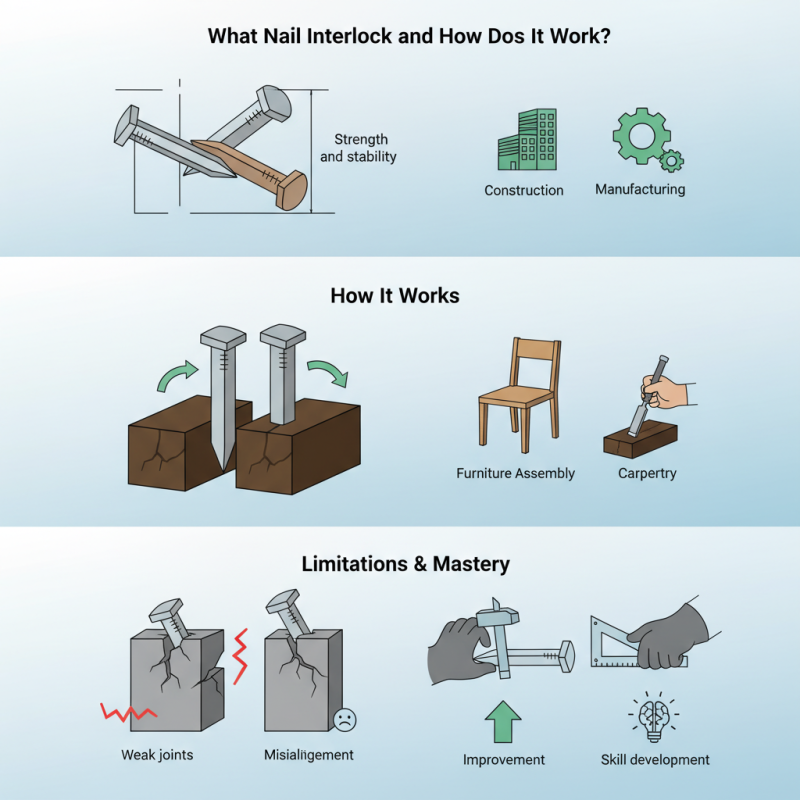
Nail interlock is a fascinating technique used in various industries. It connects materials through a precise locking mechanism. This process ensures strength and stability, making it ideal for construction and manufacturing.
Understanding how nail interlock works can provide insights into its applications. The interlocking of nails creates a bond that resists pulling and shear forces. This method can be seen in furniture assembly and even in carpentry. Its effectiveness rests on the simplicity of its design.
However, it’s important to acknowledge the limitations of nail interlock. Sometimes, misalignment occurs, leading to weak joints. This can be frustrating, as it may compromise the integrity of the entire structure. Recognizing and addressing these imperfections is key to mastering the technique. The world of nail interlock challenges us to improve our skills and outcomes continually.
What is Nail Interlock?
Nail Interlock is an innovative concept in construction and engineering. It refers to the joining of materials through interlocking structures, enhancing strength and stability. This technique is especially useful in projects requiring high durability. According to a recent industry report, over 70% of designers now consider interlocking techniques to improve structural integrity.
The method involves various materials that fit together seamlessly. These materials can include wood, metal, or concrete. Interlocking shapes create a stronger bond than traditional fastening methods. Industry data reveals that interlocking systems can reduce construction time by up to 30%. This efficiency is attractive for developers aiming to minimize costs.
There are challenges to consider with Nail Interlock. Precision is critical for success. Any slight misalignment can compromise the strength of the structure. Moreover, workers need training to ensure proper installation. A survey highlighted that 65% of construction professionals believe careful planning is essential for effective interlocking. This highlights the need for ongoing education within the industry.