

For support and service of your machinery, Stiles has experts available 24/7 to help reduce downtime and get you back in action.
Technical Support: 616-698-6615
Service & Repairs: 616-698-7500
24/7 Parts: 1-800-727-8780
sale@inlandmachineokc.com
Parts are available from Stiles 24 hours a day, seven days a week, and are shipped from our Grand Rapids, Michigan fulfillment center.
24/7 Parts: 800-727-8780

With a customized Stiles University course, we can provide expert training for your team, on-location. Whether it's programming, operation or maintenance, we want to help you train your personnel to meet your production goals efficiently and effectively.

Experience the trusted workforce development training and machinery knowledge you rely on from Stiles University, now at your convenience. With technology changing every day and new methods being developed constantly, Stiles University Online has the latest information and training content available at your fingertips.
616-698-7500

Do you want to produce more efficiently? Processes and flows are key. We optimize these together with you, re-organize them and make sure that you reduce your lead time and save costs. This enables you to implement customized manufacturing and achieve your business goals.

Industrialized construction is evolving. Automation, robotics and advanced technology are raising the level of productivity, efficiency and precision for builders in North America.

Stiles Machinery is at the forefront of providing technology and machining for producing high quality mass timber. Automated solutions for your mass timber production can increase your manufacturing quality and productivity.

Project management services from Stiles make it easy to streamline your entire project— from concept and consultation to integration and implementation.
For support and service of your machinery, Stiles has experts available 24/7 to help reduce downtime and get you back in action.
Technical Support: 616-698-6615
Service & Repairs: 616-698-7500
24/7 Parts: 1-800-727-8780
sale@inlandmachineokc.com
Parts are available from Stiles 24 hours a day, seven days a week, and are shipped from our Grand Rapids, Michigan fulfillment center.
24/7 Parts: 800-727-8780

With a customized Stiles University course, we can provide expert training for your team, on-location. Whether it's programming, operation or maintenance, we want to help you train your personnel to meet your production goals efficiently and effectively.

Experience the trusted workforce development training and machinery knowledge you rely on from Stiles University, now at your convenience. With technology changing every day and new methods being developed constantly, Stiles University Online has the latest information and training content available at your fingertips.
616-698-7500

Do you want to produce more efficiently? Processes and flows are key. We optimize these together with you, re-organize them and make sure that you reduce your lead time and save costs. This enables you to implement customized manufacturing and achieve your business goals.

Industrialized construction is evolving. Automation, robotics and advanced technology are raising the level of productivity, efficiency and precision for builders in North America.

Stiles Machinery is at the forefront of providing technology and machining for producing high quality mass timber. Automated solutions for your mass timber production can increase your manufacturing quality and productivity.

Project management services from Stiles make it easy to streamline your entire project— from concept and consultation to integration and implementation.
For support and service of your machinery, Stiles has experts available 24/7 to help reduce downtime and get you back in action.
Technical Support: 616-698-6615 Service & Repairs: 616-698-7500 24/7 Parts: 1-800-727-8780
Parts are available from Stiles 24 hours a day, seven days a week, and are shipped from our Grand Rapids, Michigan fulfillment center.
24/7 Parts: 800-727-8780For support and service of your machinery, Stiles has experts available 24/7 to help reduce downtime and get you back in action.
Technical Support: 616-698-6615 Service & Repairs: 616-698-7500 24/7 Parts: 1-800-727-8780
Parts are available from Stiles 24 hours a day, seven days a week, and are shipped from our Grand Rapids, Michigan fulfillment center.
24/7 Parts: 800-727-8780Choosing the right fixture shoulder screw is crucial for optimal assembly and functionality. Industry reports indicate that improper selection can lead to installation failures, wasting both time and resources. According to a study by the Mechanical Fasteners Association, nearly 30% of mechanical failures are linked to incorrect screw applications.
Expert John Mitchell, a renowned figure in the fastening technology sector, emphasizes, “The right fixture shoulder screw can significantly enhance the performance of a mechanical system.” His insights highlight the necessity of understanding material compatibility, load requirements, and assembly precision when making a choice.
In today's market, countless variations of fixture shoulder screws exist, which complicates the selection process. Without careful consideration, a mismatched screw can undermine an entire project. Professionals need to weigh their options critically. This often means revisiting initial assumptions and exploring new possibilities for improvement in their assembly processes.
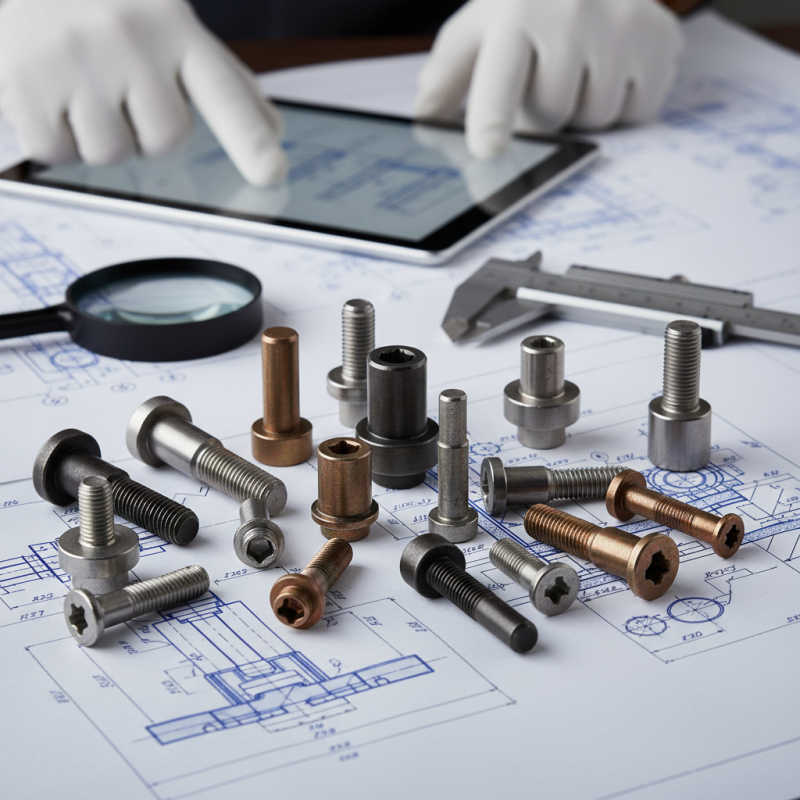
Fixture shoulder screws are critical components in various applications, from machinery to electronics. Understanding their structure and function helps in choosing the right screw for your project. These screws are designed to provide support and guidance, ensuring stability in assembly processes. Their unique shoulder allows for precise alignment, which is essential in applications requiring exact tolerances.
Industry reports indicate that improper selection of fixture shoulder screws can lead to assembly failures. For example, a report by the Fastener Quality Act shows that 20% of assembly-related issues stem from using inadequate fasteners. This statistic emphasizes the need for careful consideration. Selecting the wrong screw can lead to costly downtime and rework.
In addition, fixture shoulder screws come in various materials, including stainless steel and plastics. Each material has its own properties, influencing strength, corrosion resistance, and thermal stability. The choice of material should reflect the specific environmental conditions of the application. Some applications might expose screws to extreme temperatures or moisture. Evaluating these conditions is vital yet often overlooked in the selection process. Thus, understanding the nuances of fixture shoulder screws can significantly impact overall project success.
Choosing the right fixture shoulder screw can significantly impact your project's success. Several factors come into play when making this decision. First, consider the material of the screw. Stainless steel provides excellent corrosion resistance, while other materials may be more suited for specific environments.
Next, examine the size and length of the screw. A shoulder screw that is too short might not provide adequate support. On the other hand, an excessively long screw can cause alignment issues. Pay attention to thread size and pitch as well. These factors influence how well the screw fits into its designated hole.
Lastly, don't overlook the screw's head design. Different designs serve various purposes. Some provide better torque, while others allow for easier access in tight spaces. Reflecting on your specific application can guide your choice. Evaluate your options carefully, as mistakes can be costly. Remember, the right fixture shoulder screw is crucial for functional and reliable performance.
Choosing the right material for fixture shoulder screws is critical in ensuring durability and performance. These screws hold fixtures together and require a robust material to withstand mechanical stresses. Steel is often the go-to choice. However, not all steel is created equal. You may need stainless steel for corrosion resistance, especially in humid environments.
On the other hand, aluminum offers a lightweight alternative. It's important to consider the trade-offs. Aluminum might not be as strong as steel, but it can provide excellent weight savings. For applications requiring higher strength-to-weight ratios, titanium could be considered, though it comes at a higher cost.
Periodic experimentation with materials can yield surprising results. Trying different alloys or coatings may improve performance over time. Yet, it’s essential to reflect on failures. If a screw fails, analyzing the material choice is vital. Did it corrode? Was it too brittle? Learning from these mistakes can guide future selections. The right material leads to better overall performance and reliability.
When selecting fixture shoulder screws, understanding sizing and dimensions is crucial. These screws exhibit a shoulder that serves as a positioning feature, providing stability in assemblies. Typically, the shoulder diameter will vary according to the application requirements. Industry reports show that most shoulder screws range from 2 mm to 20 mm in diameter, with lengths also adjusting from 10 mm to 100 mm, depending on the fixture design.
Precision in measurements is essential. A report by the American Society of Mechanical Engineers (ASME) notes that tolerances for shoulder diameter should ideally be kept within ±0.05 mm. This ensures a proper fit in applications, where a loose fit could lead to system inefficiencies.
Additionally, screw length must accommodate the thickness of the materials being joined. Choosing an incorrect length can result in expensive rework and delays.
Consideration of materials is equally vital. Stainless steel is commonly favored for its corrosion resistance. However, lighter materials like aluminum may be preferable in applications where weight is a concern. Balancing the need for strength and weight is often a challenge. Ultimately, the goal is to achieve a secure and reliable assembly while minimizing costs and material waste. Each choice carries implications that reflect on overall assembly integrity.
Selecting the right fixture shoulder screw can be challenging. Many make common mistakes during this process. One frequent error is neglecting the material compatibility. Different applications require various materials. For instance, stainless steel offers corrosion resistance, while aluminum is lighter. Understanding the unique environment and loads will guide the material choice.
Another mistake is overlooking the screw size and thread type. Using the wrong dimensions can lead to weak joints or premature failure. Pay attention to the diameter and length specifications. This step often gets overlooked in the design phase. Note that using too short a screw may not provide adequate grip. Conversely, overly long screws may damage components.
Lastly, it's easy to underestimate the importance of quality. Cheap fixtures may save money initially but lead to issues later. Investing in reliable screws ensures safety and durability. If you notice persistent failures in your assembly, reconsider your screw selection. Reflect on past experiences to refine your choices. The right fixture shoulder screw may be the linchpin in achieving a robust assembly.







