
For support and service of your machinery, Stiles has experts available 24/7 to help reduce downtime and get you back in action.
Technical Support: 616-698-6615
Service & Repairs: 616-698-7500
24/7 Parts: 1-800-727-8780
sale@inlandmachineokc.com
Parts are available from Stiles 24 hours a day, seven days a week, and are shipped from our Grand Rapids, Michigan fulfillment center.
24/7 Parts: 800-727-8780

With a customized Stiles University course, we can provide expert training for your team, on-location. Whether it's programming, operation or maintenance, we want to help you train your personnel to meet your production goals efficiently and effectively.

Experience the trusted workforce development training and machinery knowledge you rely on from Stiles University, now at your convenience. With technology changing every day and new methods being developed constantly, Stiles University Online has the latest information and training content available at your fingertips.
616-698-7500

Do you want to produce more efficiently? Processes and flows are key. We optimize these together with you, re-organize them and make sure that you reduce your lead time and save costs. This enables you to implement customized manufacturing and achieve your business goals.

Industrialized construction is evolving. Automation, robotics and advanced technology are raising the level of productivity, efficiency and precision for builders in North America.

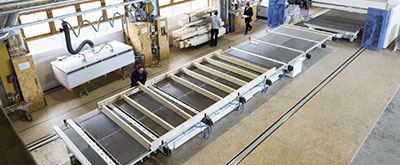
Stiles Machinery is at the forefront of providing technology and machining for producing high quality mass timber. Automated solutions for your mass timber production can increase your manufacturing quality and productivity.

Project management services from Stiles make it easy to streamline your entire project— from concept and consultation to integration and implementation.
For support and service of your machinery, Stiles has experts available 24/7 to help reduce downtime and get you back in action.
Technical Support: 616-698-6615
Service & Repairs: 616-698-7500
24/7 Parts: 1-800-727-8780
sale@inlandmachineokc.com
Parts are available from Stiles 24 hours a day, seven days a week, and are shipped from our Grand Rapids, Michigan fulfillment center.
24/7 Parts: 800-727-8780

With a customized Stiles University course, we can provide expert training for your team, on-location. Whether it's programming, operation or maintenance, we want to help you train your personnel to meet your production goals efficiently and effectively.

Experience the trusted workforce development training and machinery knowledge you rely on from Stiles University, now at your convenience. With technology changing every day and new methods being developed constantly, Stiles University Online has the latest information and training content available at your fingertips.
616-698-7500

Do you want to produce more efficiently? Processes and flows are key. We optimize these together with you, re-organize them and make sure that you reduce your lead time and save costs. This enables you to implement customized manufacturing and achieve your business goals.

Industrialized construction is evolving. Automation, robotics and advanced technology are raising the level of productivity, efficiency and precision for builders in North America.

Stiles Machinery is at the forefront of providing technology and machining for producing high quality mass timber. Automated solutions for your mass timber production can increase your manufacturing quality and productivity.

Project management services from Stiles make it easy to streamline your entire project— from concept and consultation to integration and implementation.
For support and service of your machinery, Stiles has experts available 24/7 to help reduce downtime and get you back in action.
Technical Support: 616-698-6615 Service & Repairs: 616-698-7500 24/7 Parts: 1-800-727-8780
Parts are available from Stiles 24 hours a day, seven days a week, and are shipped from our Grand Rapids, Michigan fulfillment center.
24/7 Parts: 800-727-8780For support and service of your machinery, Stiles has experts available 24/7 to help reduce downtime and get you back in action.
Technical Support: 616-698-6615 Service & Repairs: 616-698-7500 24/7 Parts: 1-800-727-8780
Parts are available from Stiles 24 hours a day, seven days a week, and are shipped from our Grand Rapids, Michigan fulfillment center.
24/7 Parts: 800-727-8780Choosing Optical Sorting Systems in 2026 starts with the material, not the machine. A food processor sorting leafy greens faces different challenges from a plastics recycler separating mixed flakes. Product color, moisture, size, line speed, and acceptable reject rates all shape the right configuration. Small details matter.
The scale of food loss gives this decision real weight. The FAO’s The State of Food and Agriculture 2023 estimates that 13.2% of food is lost between harvest and retail. UNEP’s Food Waste Index Report 2024 estimates that 1.05 billion tonnes of food were wasted in 2022 across retail, food service, and households. These figures describe broad system losses, not losses that optical sorting alone can prevent. Still, they show why accurate inspection and better process control deserve attention.
In practice, compare camera, near-infrared, and other sensor options against your actual sorting target. Ask suppliers to test representative samples, including difficult cases such as overlapping pieces, variable lighting, or changing moisture. Then review verified throughput, purity, recovery, reject handling, cleaning needs, and integration with existing conveyors. A polished demonstration is not enough. Request results under conditions close to your own line. Check how the supplier defines accuracy, too; one impressive number can hide trade-offs between product recovery and contaminant removal. Optical Sorting Systems can improve consistency, but performance depends on calibration, maintenance, and material variability. The choice is rarely perfect. A useful evaluation makes the compromises visible before installation.

Before comparing optical sorting systems, define what a successful sort means for your operation. Specify feed rate, target material, unwanted particles, and acceptable product loss. A line removing dark fragments from clear flakes has different needs from one separating mixed grains by color. Set measurable limits, such as maximum contamination per kilogram, rather than relying on “clean enough.” Small details matter.
Record material characteristics across real production shifts. Note particle size, shape, moisture, dust, surface condition, and color variation. These factors can change how reliably sensors distinguish one fraction from another. Include normal fluctuations, not just ideal samples. A dry, evenly spread sample may look easy to sort; damp, overlapping pieces can behave differently. It is easy to overlook these conditions during a brief demonstration. That choice can lead to a poor fit later.
Tips: Test representative samples at realistic belt speeds. Ask for results on both purity and yield, and keep the test settings. Check how often recipes need adjustment when material changes. The inconvenient sample may teach you the most.
Optical sensors differ in what they detect, so match the technology to the material and defect. RGB cameras capture visible color and shape, making them useful for spotting stains, broken pieces, or size variation. Near-infrared sensors can distinguish materials with different spectral responses, even when their colors look similar. Hyperspectral systems collect more wavelength detail, but often require careful setup and produce more data to interpret. Laser-based 3D detection measures surface shape and height. Small details matter.
Tips: Ask suppliers to test your actual material, including dusty, damp, and unusually colored samples. Check detection accuracy at your intended belt speed, not just in a slow demonstration. Record both missed defects and good items rejected by mistake.
A sensor can look excellent on paper and still disappoint under changing light or uneven product flow. Request clear test conditions, sample sizes, and definitions of a successful result. Also check how often lenses need cleaning and whether operators can adjust thresholds without specialist support. These practical details affect day-to-day reliability. It is easy to overvalue a feature-rich system; sometimes the simpler sensor is the better fit.
Choosing an optical sorting system starts with a clear definition of accuracy. Ask what the supplier counts as a correct decision, and request results for your own material. A clean sample can hide problems caused by dust, overlapping items, moisture, or changing colors. Track both missed defects and good material rejected by mistake. Small details matter. Test across different batches and operating speeds, not just during a polished demonstration. Record the incoming mix, sorting settings, and output quality so comparisons remain fair.
Throughput should mean sustained production, not a brief peak on a quiet line. Watch the feed belt during a realistic run; uneven spacing can reduce performance even when the sensor is fast. Check how the system exchanges signals with existing controls, conveyors, and reject mechanisms. Confirm who handles alarms, recipe changes, and production data. Integration often looks easy on a diagram. On the floor, a delayed air pulse or awkward access panel can create avoidable stoppages. Leave room for maintenance, and verify that operators can adjust settings without losing traceability. A trial may still reveal gaps in your test plan; that is useful evidence, not a reason to ignore the results.
Software affects more than sorting accuracy. Check whether operators can adjust product recipes, review rejection images, and export performance data without specialist help. Ask to see these tasks demonstrated on a sample production run. Confirm how updates, user access, and data storage are handled. A low purchase price can hide recurring software fees or costly integration work.
Maintenance and lifecycle costs deserve equal attention. The U.S. Department of Energy’s Operations & Maintenance Best Practices Guide reports that predictive maintenance can cost 8–12% less than preventive maintenance, and 30–40% less than reactive maintenance. These are general industry benchmarks, not guaranteed savings for optical sorters. Request documented service intervals, spare-part lead times, and expected sensor replacement costs. A dusty lens or delayed replacement can quickly reduce usable line time. Estimates can miss real-world friction.
Tips: Compare total costs over the same operating period, including installation, training, software, energy, maintenance, and downtime. Ask suppliers for service records from comparable applications. Then test how quickly your own team can diagnose a simulated fault. The test may be imperfect, but that’s useful: it reveals what still needs checking.
Before selecting an optical sorting system, test it with material that resembles your actual feed, not only clean demonstration samples. Include differences in size, color, moisture, surface dust, and natural defects. Ask the supplier to record throughput, recovery, and reject rates under stated conditions. Measure twice.
Run repeated trials at the line speed you expect to use. Keep the feed rate consistent, then introduce realistic changes, such as a damp batch or uneven lighting. Check whether the system separates target items without discarding too much acceptable material. Review images and reject samples by hand; a high headline accuracy can hide costly false rejects. That matters.
Validation should include operators and maintenance staff, not just engineers. Ask them to clean the viewing window, adjust settings, and restart the machine using normal procedures. Record setup time, stoppages, and results across shifts. A short test cannot capture every seasonal or product variation, and that limitation deserves attention. I would also question results that cannot be repeated. Request raw test data, clear definitions for each metric, and agreed acceptance thresholds before purchase. Then compare performance on your site, where vibration, dust, and changing feed conditions may differ from a controlled test area.