

For support and service of your machinery, Stiles has experts available 24/7 to help reduce downtime and get you back in action.
Technical Support: 616-698-6615
Service & Repairs: 616-698-7500
24/7 Parts: 1-800-727-8780
sale@inlandmachineokc.com
Parts are available from Stiles 24 hours a day, seven days a week, and are shipped from our Grand Rapids, Michigan fulfillment center.
24/7 Parts: 800-727-8780

With a customized Stiles University course, we can provide expert training for your team, on-location. Whether it's programming, operation or maintenance, we want to help you train your personnel to meet your production goals efficiently and effectively.

Experience the trusted workforce development training and machinery knowledge you rely on from Stiles University, now at your convenience. With technology changing every day and new methods being developed constantly, Stiles University Online has the latest information and training content available at your fingertips.
616-698-7500

Do you want to produce more efficiently? Processes and flows are key. We optimize these together with you, re-organize them and make sure that you reduce your lead time and save costs. This enables you to implement customized manufacturing and achieve your business goals.

Industrialized construction is evolving. Automation, robotics and advanced technology are raising the level of productivity, efficiency and precision for builders in North America.

Stiles Machinery is at the forefront of providing technology and machining for producing high quality mass timber. Automated solutions for your mass timber production can increase your manufacturing quality and productivity.

Project management services from Stiles make it easy to streamline your entire project— from concept and consultation to integration and implementation.
For support and service of your machinery, Stiles has experts available 24/7 to help reduce downtime and get you back in action.
Technical Support: 616-698-6615
Service & Repairs: 616-698-7500
24/7 Parts: 1-800-727-8780
sale@inlandmachineokc.com
Parts are available from Stiles 24 hours a day, seven days a week, and are shipped from our Grand Rapids, Michigan fulfillment center.
24/7 Parts: 800-727-8780

With a customized Stiles University course, we can provide expert training for your team, on-location. Whether it's programming, operation or maintenance, we want to help you train your personnel to meet your production goals efficiently and effectively.

Experience the trusted workforce development training and machinery knowledge you rely on from Stiles University, now at your convenience. With technology changing every day and new methods being developed constantly, Stiles University Online has the latest information and training content available at your fingertips.
616-698-7500

Do you want to produce more efficiently? Processes and flows are key. We optimize these together with you, re-organize them and make sure that you reduce your lead time and save costs. This enables you to implement customized manufacturing and achieve your business goals.

Industrialized construction is evolving. Automation, robotics and advanced technology are raising the level of productivity, efficiency and precision for builders in North America.

Stiles Machinery is at the forefront of providing technology and machining for producing high quality mass timber. Automated solutions for your mass timber production can increase your manufacturing quality and productivity.

Project management services from Stiles make it easy to streamline your entire project— from concept and consultation to integration and implementation.
For support and service of your machinery, Stiles has experts available 24/7 to help reduce downtime and get you back in action.
Technical Support: 616-698-6615 Service & Repairs: 616-698-7500 24/7 Parts: 1-800-727-8780
Parts are available from Stiles 24 hours a day, seven days a week, and are shipped from our Grand Rapids, Michigan fulfillment center.
24/7 Parts: 800-727-8780For support and service of your machinery, Stiles has experts available 24/7 to help reduce downtime and get you back in action.
Technical Support: 616-698-6615 Service & Repairs: 616-698-7500 24/7 Parts: 1-800-727-8780
Parts are available from Stiles 24 hours a day, seven days a week, and are shipped from our Grand Rapids, Michigan fulfillment center.
24/7 Parts: 800-727-8780Choosing the best Hard Facing Welding Wire Line is crucial for industries that demand durability. Hard facing welding wires are designed to enhance the wear resistance of metal surfaces. According to a report by the American Welding Society, nearly 30% of manufacturing downtime is related to equipment wear. Selecting the right welding wire can significantly reduce this downtime.
Industry expert John Smith emphasizes the importance of careful selection. He states, "The right welding wire can extend equipment life and improve operational efficiency." His insights highlight how the correct Hard Facing Welding Wire Line not only meets specific wear conditions but also aligns with production goals.
When evaluating options, consider material compatibility and application requirements. The ideal Hard Facing Welding Wire Line should provide excellent adhesion and toughness. However, the wrong choice can lead to flaws, such as cracking or poor bonding. Balancing performance with cost is essential. Each selection should reflect both immediate needs and long-term goals.
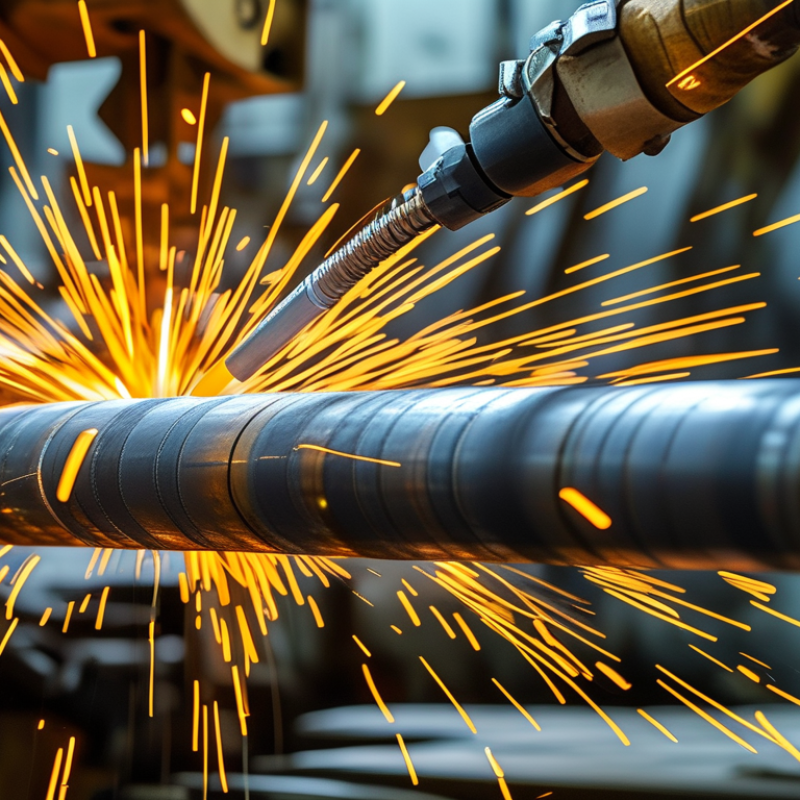
Hard facing welding wire is critical in many industrial applications. This special wire is designed to enhance wear resistance on surfaces subjected to high stress. Industries like mining, construction, and manufacturing benefit significantly from hard facing techniques. According to a study by the American Welding Society, over 70% of mechanical failures in these sectors are due to wear and abrasion.
The applications of hard facing welding wire are diverse. It's utilized in rebuilding worn parts like gears and conveyor screws. These applications can dramatically extend the life of components. A report by the International Journal of Advanced Manufacturing Technology indicates that hard facing can improve the lifespan of equipment by up to 60%. However, not all hard facing wires are created equal.
Choosing the right hard facing wire involves understanding metal composition and application. For instance, high chromium carbide weld deposits are excellent for high-temperature environments. On the other hand, low alloy steels may suffice for lighter tasks. In practice, operators often overlook specific requirements. The technical specifications can seem overwhelming, yet they are fundamental for achieving successful results.
Choosing the right hard facing welding wire is essential for optimal wear resistance. When selecting the wire, consider material compatibility with the base metal. The correct choice enhances performance and prolongs equipment life, especially in high-impact or abrasive environments. A study by the American Welding Society states that up to 30% of welding defects arise from material mismatch.
Welding processes also play a critical role in wire selection. For instance, SMAW (Shielded Metal Arc Welding) can achieve better control in field applications. Conversely, GMAW (Gas Metal Arc Welding) is often preferred for its speed and versatility in shop settings. Different processes may require different wire compositions, affecting the final quality.
Pay attention to the wire's hardness rating, especially for heavy-duty applications. Hard facing wire often ranges from 30 to 65 HRC (Rockwell Hardness Scale). The type of alloying elements can influence both hardness and wear resistance. However, harder wires can be more brittle, leading to crack susceptibility. This is an area where manufacturers must carefully balance performance and durability.
Choosing the right hard facing welding wire is essential for durability. Various types exist in the market, each suitable for different applications. Common types include chromium carbide wires, nickel-based wires, and cobalt-based wires. Each offers unique properties. Chromium carbide is known for its hardness, while nickel wires offer flexibility and resistance to corrosion.
When selecting a welding wire, consider the material you are working with. Different base metals require different fillers. It's crucial to match the wire to the application. For high-wear applications, choose a wire with high carbide content. For moderate wear, a lower carbide content might suffice.
Tips: Always test a small area before full application. This can help assess compatibility. Look for user reviews or seek advice from experienced welders. Observing others can reveal common mistakes. Sometimes, what works for one project may not work for another. Don't rush the process; evaluate your options thoroughly, and reflect on past experiences to guide your choice.
When evaluating hard facing welding wires, it's crucial to focus on performance characteristics. Hard facing wires are engineered to resist wear and impact. The composition of the wire directly influences its wear resistance and hardness. Typically, a higher alloy content results in increased durability. Understanding the metallurgical properties can help you select the right wire.
It's essential to consider the application and service environment. Some wires perform better in extreme temperatures or corrosive conditions. Testing the wire's performance in real-world scenarios can provide invaluable insights. A wire that excels in one area may falter in another.
Welding parameters play a significant role too. Amperage, voltage, and travel speed affect the quality of the weld. Experimenting with these variables can help achieve optimal results. However, not every trial will yield success. Adapting and learning from less-than-ideal outcomes is part of the process. Reviewing the results can inform future decisions, enhancing the reliability of your choices in hard facing welding wires.
Hard facing welding wire is a valuable tool for enhancing the durability of metal surfaces. To use it effectively, preparation is key. Ensure the base metal is clean and free from contaminants. Rust, grease, or paint can hinder adherence, compromising your weld. Appropriate surface preparation can greatly improve the bond.
Another important aspect is selecting the right wire diameter for your application. Thicker wires are used for more substantial wear, while thinner wires work well for precise applications. Always adjust your welding parameters according to the wire you choose. Monitor the heat input to avoid distortion of the base metal. Setting too high a current can lead to poor penetration or even defects in the weld.
While experience enhances your hard facing technique, mistakes can still happen. For example, under or overheating the weld can cause cracking. Take time to reflect on each project. Analyze what went well and what didn’t. Learn from these experiences to improve future applications. Remember, the ultimate goal is a strong, reliable bond.
| Criteria | Description | Recommended Type |
|---|---|---|
| Material Compatibility | Ensure the wire matches the base materials to be welded. | Chromium Carbide |
| Wear Resistance | Evaluate the level of wear the material will encounter. | Cobalt-based Alloys |
| Operating Temperature | Select a wire suitable for the expected service temperature. | Nickel-based Alloys |
| Processing Conditions | Consider the welding process and position. | Flux-cored Wires |
| Application Environment | Assess whether the environment is corrosive or abrasive. | Hardfacing Wires with Alloy Additives |







