
-
-
-
-
-
-

With a customized Stiles University course, we can provide expert training for your team, on-location. Whether it's programming, operation or maintenance, we want to help you train your personnel to meet your production goals efficiently and effectively.
-

Experience the trusted workforce development training and machinery knowledge you rely on from Stiles University, now at your convenience. With technology changing every day and new methods being developed constantly, Stiles University Online has the latest information and training content available at your fingertips.
-
-
-

Do you want to produce more efficiently? Processes and flows are key. We optimize these together with you, re-organize them and make sure that you reduce your lead time and save costs. This enables you to implement customized manufacturing and achieve your business goals.
-

Industrialized construction is evolving. Automation, robotics and advanced technology are raising the level of productivity, efficiency and precision for builders in North America.
-

Stiles Machinery is at the forefront of providing technology and machining for producing high quality mass timber. Automated solutions for your mass timber production can increase your manufacturing quality and productivity.
-

Project management services from Stiles make it easy to streamline your entire project— from concept and consultation to integration and implementation.
-



-
-
-
-
-
-
With a customized Stiles University course, we can provide expert training for your team, on-location. Whether it's programming, operation or maintenance, we want to help you train your personnel to meet your production goals efficiently and effectively.
-
Experience the trusted workforce development training and machinery knowledge you rely on from Stiles University, now at your convenience. With technology changing every day and new methods being developed constantly, Stiles University Online has the latest information and training content available at your fingertips.
-
-
-
Do you want to produce more efficiently? Processes and flows are key. We optimize these together with you, re-organize them and make sure that you reduce your lead time and save costs. This enables you to implement customized manufacturing and achieve your business goals.
-
Industrialized construction is evolving. Automation, robotics and advanced technology are raising the level of productivity, efficiency and precision for builders in North America.
-
Stiles Machinery is at the forefront of providing technology and machining for producing high quality mass timber. Automated solutions for your mass timber production can increase your manufacturing quality and productivity.
-
Project management services from Stiles make it easy to streamline your entire project— from concept and consultation to integration and implementation.
-
Top 10 Benefits of Using an Adjusting Rod in Your Projects?
In the world of construction and design, the "Adjusting Rod" plays a crucial role. Industry expert Dr. James Harper once said, "Precision in measurements creates a foundation for success." This highlights the importance of using an adjusting rod in various projects.
Adjusting rods offer multiple benefits that enhance both the efficiency and accuracy of work. They allow for simple adjustments, ensuring perfect alignment during installations. This tool reduces time spent on rework, making projects more efficient. Moreover, adjusting rods are lightweight and easy to handle. Their versatility caters to various applications, from framework to intricate designs.
However, not using an adjusting rod can lead to errors. Misalignment results in costly mistakes. Some may overlook its significance, but stories of failures due to improper alignment remind us. Using an adjusting rod can prevent these pitfalls. Embracing this tool can elevate the quality of your projects and reduce the risk of regret later on.
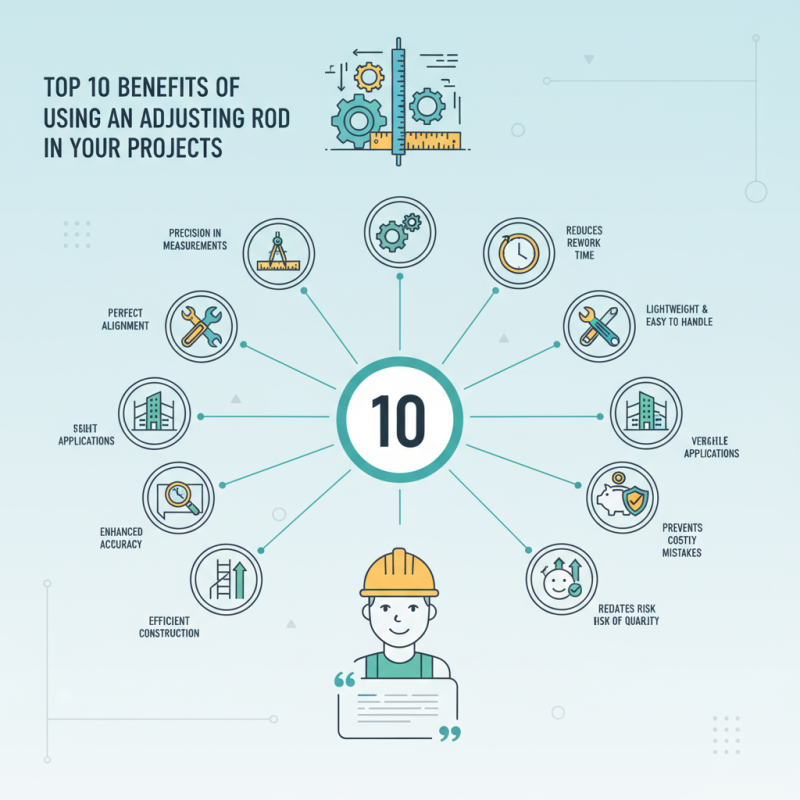
Benefits of Improved Precision and Accuracy in Projects
Precision and accuracy are crucial in any project. An adjusting rod can significantly enhance these aspects. By allowing for fine-tuning of measurements, it minimizes errors that often occur due to misalignment. Imagine trying to build a structure without precise measurements. Even small inaccuracies can lead to major problems down the line. An adjusting rod ensures that every detail is accounted for, ultimately leading to a more refined outcome.
In many projects, the difference between success and failure lies in precision. An adjusting rod lets you adjust your angles, lengths, and alignments effortlessly. This tool provides the capability to make micro-adjustments, allowing workers to rectify mistakes immediately. Yet, this doesn’t mean it’s always flawless. Sometimes, over-reliance on a tool can create a false sense of security. It’s crucial to remain vigilant and double-check measurements, as human error can still creep in. Using an adjusting rod increases accuracy, but it doesn’t eliminate the need for careful planning and execution.